Ventilation and hoods
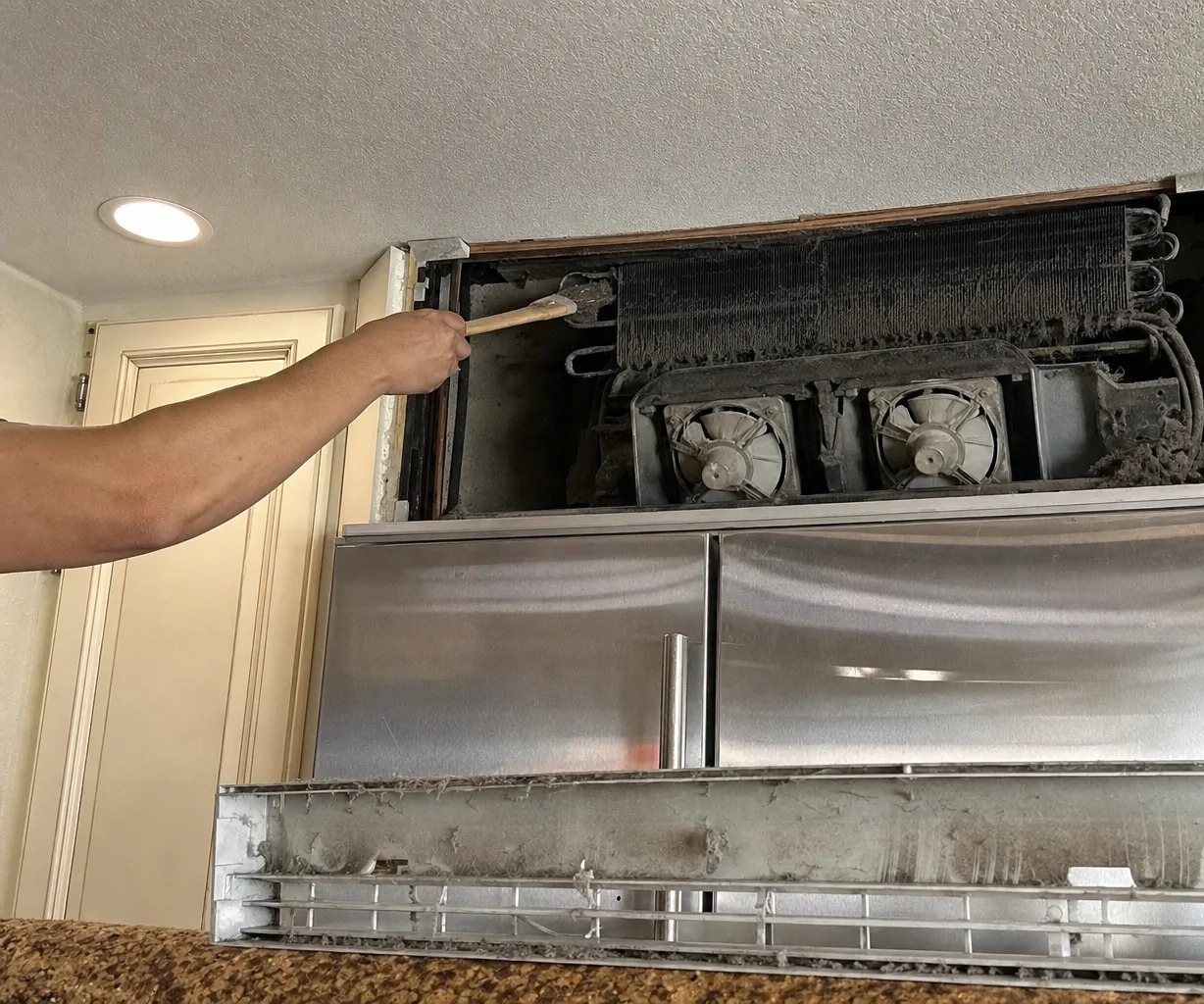
Thermador hood blower rumble and weak extraction
Wall and island hoods, custom inserts, downdraft units and remote blowers — noise, weak extraction, lighting and control faults.
The appliance the beach attacks first
Ventilation is the equipment that fails earliest on this coast, and the reason is simple: it is the only appliance in the kitchen whose job is to move outside air. Every hour the hood runs, it pulls air from a house a few blocks from the Atlantic, through a motor assembly, and out through a duct that terminates in salt spray.
Inland, a hood blower is close to a lifetime component. Here it is a wear item.
Kitchen ventilation, not house ventilation
Because this page is full of ducts and airflow, one sentence to head off the wrong telephone call: this is the hood above the cooktop and the run of pipe from it to the cap on the outside wall, and nothing else. We do not service heating systems, furnaces, heat pumps, air handlers or air conditioning, and we do not work on the supply and return ductwork that moves conditioned air around a house. That is a different trade.
Where the two meet is worth knowing, though, because it explains a hood that has gone quiet on you. A hood that throws air out of a sealed house needs air to come back in from somewhere. In a tightly built beach house there is nowhere for it to come from, so the blower spins at full speed and clears almost nothing. We measure that before condemning a motor — but the fix on the house side, when it needs one, is specified and fitted by a mechanical contractor rather than by us.
Noise is the first warning, not the failure
Blower motors on wall hoods, island hoods and custom inserts run on bearings. Salt-laden humid air reaches those bearings through the same path the cooking air takes. The lubricant degrades, the bearing surface roughens, and the balance of the squirrel-cage wheel changes as grease and salt build unevenly on the blades.
What you hear first is a low rumble at low speed or a rising whine at boost. What follows, usually within a season or two, is a motor that draws more current, runs hot, and either seizes or trips its thermal protector mid-cook.
Catching it at the noise stage matters, because at that point the fix is often cleaning and rebalancing the wheel plus a bearing or motor replacement. After a seizure you are frequently replacing the whole blower assembly and sometimes the control that fed it.
Weak extraction is rarely the motor
When a hood stops clearing steam and smoke, owners assume the motor is tired. It usually is not. In order of how often we find them:
Grease filters loaded past the point where a dishwasher run recovers them. Beach kitchens cook a lot of fish and a lot of oil, and a baffle filter that looks clean from below can be packed on the upper face.
A remote or inline blower installed in an attic or on an exterior wall, where this coast’s weather reaches it directly. Roof and wall caps corrode, dampers seize part-open or part-closed, and screens behind them clog with lint and salt crust.
Duct runs that were never right — too many elbows, a reduction from the hood collar to a smaller pipe, or a flexible section that has sagged. A retrofit into an older cottage is where we find most of these.
And make-up air. A high-CFM hood in a tightly built newer house cannot exhaust what it is rated for if nothing is letting air back in. The symptom is a hood that sounds like it is working hard and moves very little.
Downdraft units
Downdraft ventilation adds a mechanism to the list: a lift motor, a track, and limit switches that tell the control when the unit is fully up or fully down. Grease and grit migrate into that track. The unit rises partway, the control never sees the up limit, and it either stalls or retracts.
Cleaning the track and verifying the limit switches comes before any talk of a motor. When a lift motor genuinely has failed, the symptom is different — no movement and no sound, or a hum with no travel.
Corrosion on visible surfaces
Stainless steel on a hood canopy three blocks from the water will develop rust blooms if chloride is allowed to sit on it. That is surface contamination on the passive layer rather than the steel rotting through, and it responds to proper cleaning — with the grain, non-chloride products, and rinsed rather than wiped dry. What it does not respond to is a steel-wool pad, which embeds particles that rust worse than the original spots.
We will tell you when a mark is cosmetic and when a hinge, a fastener or a blower housing has actually lost material and needs replacing.
What we recommend at the beach
Filters through the dishwasher monthly, not quarterly. A look at the exterior cap and damper once a year. And a blower service at the first change in noise rather than the first failure.
Flat $80 diagnostic credited toward the repair, written estimate first, genuine OEM parts, 90 days labor and 365 days parts.
What it costs
What does ventilation and hoods work cost here?
The bands below are the ones this repair actually falls into — parts and labour, fitted, read off the same table the pricing page prints in full.
| What was actually wrong | Parts and labour, fitted |
|---|---|
| The visit and the diagnosis | $80 flat |
| Control board or touch panel | $420–$1,020 |
The $80 buys the visit and the diagnostic sequence, and it comes off the bill the moment you approve the work. Every row below is a range because what a part costs turns on which production revision is sitting in your cabinetry, and nobody knows that until the rating plate has been read. The whole table is on the pricing page.
Ventilation and hoods — asked on the phone
My hood has started to rumble. How long can I leave it?
The rumble is a bearing telling you it has begun to go, and on this coast it does not recover on its own. There is normally a season or two between the noise and a seizure, and the gap between them is the difference between replacing a wheel and replacing a motor.
Extraction has dropped but the fan sounds normal. What is that?
Look outside the appliance. A wall cap damper corroded shut, a duct squeezed through too many elbows, filters that have loaded, or a house sealed tightly enough that nothing can replace the air being thrown out will all cut the draw while the blower runs exactly as it always did.
Why do hoods fail earlier here than a few miles inland?
Because a hood is the one appliance whose work is to move air out of the house, and the damper, the wheel and the windings all sit in that stream. Salt reaches them directly, and the housing is usually the first metal in the kitchen to show what the air here is doing.
Ventilation and hoods
What owners said after this repair
4.2 out of 5, across 74 customer reviews. What is printed below is one kitchen, one call and one invoice at a time, set down by the owner who settled it.
The hood had started rattling at top speed and smelling hot. He found the blower wheel out of balance with grease on one side only, cleaned and rebalanced it, then checked the duct run back into the wall.
Verity Y.
The hood had almost no draw and the kitchen was holding smoke. He found the exterior damper corroded shut behind the wall cap, freed it, and fitted a marine-grade cap instead. The pull is back to what it used to be.
Rutherford E.
Grease had worked past the filters and deep into the housing over a long time. He degreased the interior, replaced a seized damper flap, and left the kitchen cleaner than he found it. No complaints at all.
Alaric K.
$80 flat diagnostic, credited toward the repair. Full pricing · 90 days labor, 365 days parts · All repairs
Book a visit
A flat $80 diagnostic covers the visit and the diagnosis. It is credited toward the repair if you go ahead with the work.
You get a written estimate before any part is ordered or any labor begins. Nothing is opened up on a maybe. Labor is warranted 90 days. Genuine OEM parts are warranted 365 days from the date of installation.
- Monday – Friday
- 8:00am – 6:00pm
- Saturday
- 9:00am – 4:00pm
- Note
- Closed Sunday. Scheduled appointments only — no emergency or after-hours service.