Field note
A hood that has started to rumble is telling you something
Published
The one appliance whose job is to move outside air
Every other appliance in the kitchen works with the air already in the room. A hood works with the air it is about to throw outside, which means it runs a continuous exchange between your kitchen and the coast.
A few blocks from the Atlantic, that is a hard duty cycle. Inland, a blower motor is close to a lifetime component. Here it is a wear item, and it announces itself before it fails.
What the sounds mean
A low rumble at low speed. Bearing surfaces have roughened. Salt-laden humid air has reached the bearing, degraded the lubricant, and left a surface that no longer runs smooth. At this stage the motor still works and the extraction is still close to normal.
A rising whine at boost. Usually imbalance rather than bearing wear. Grease and salt build unevenly on the squirrel-cage wheel blades, the wheel’s centre of mass moves off the shaft axis, and the vibration climbs with the square of the speed. That imbalance then accelerates bearing wear, so the two faults feed each other.
A hum with no movement. The motor is energised and the rotor is not turning. That is a seized bearing or a failed capacitor, and by that point the cheap repair window has closed.
A rattle that changes when you touch the canopy. Not the motor at all — usually a loose damper flap, a mounting screw that has backed out, or a duct section that has lost a strap.
Extraction falls before the noise does
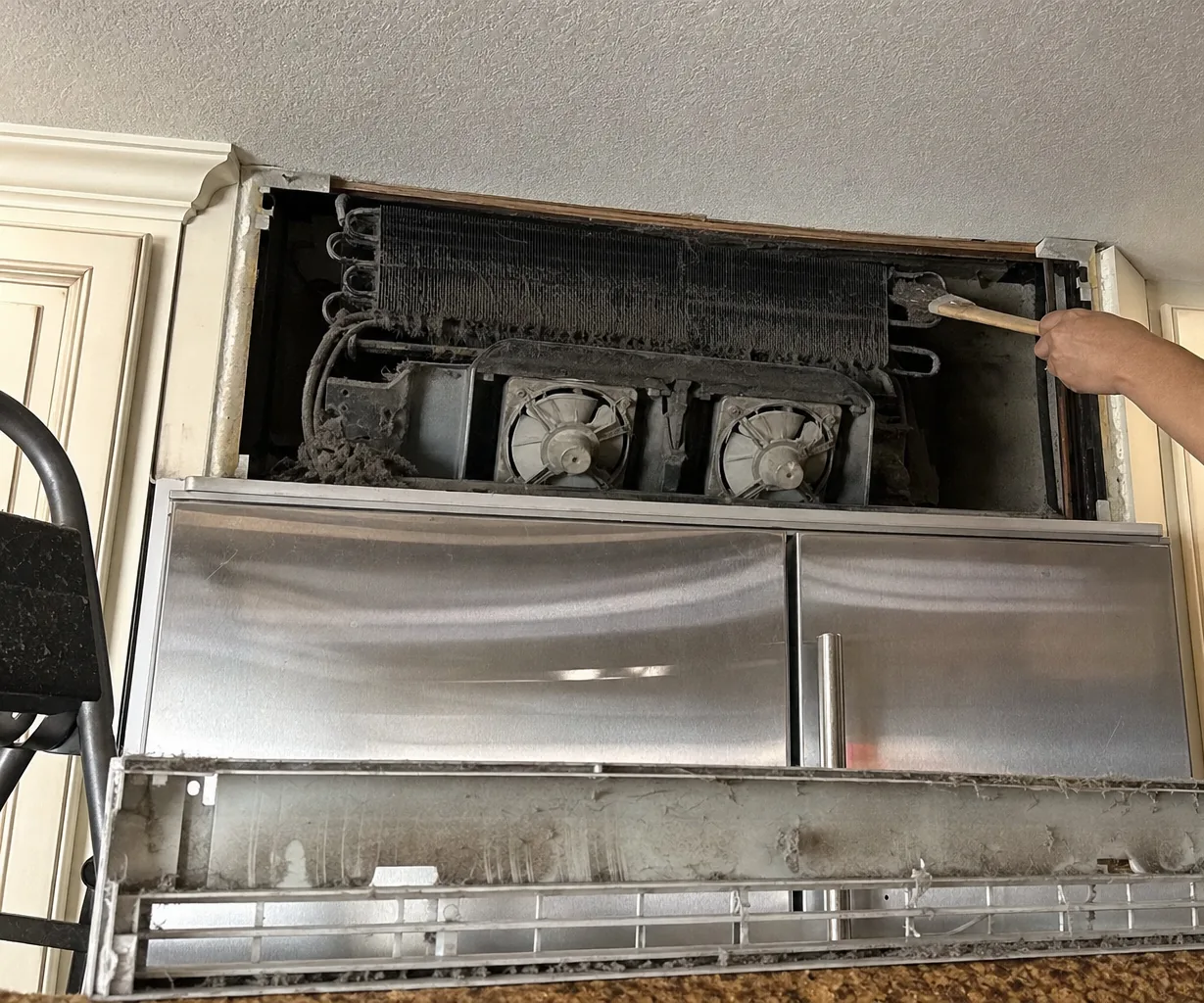
The frustrating part is that a hood’s performance drops well before the sound becomes obvious. Grease loading on the wheel adds mass and disturbs airflow over the blades. The motor draws more current to hold speed, runs hotter, and moves less air than the rating.
So the real sequence is: extraction quietly degrades, then the noise starts, then the motor fails. Most owners call at step three. Step two is where the money is.
The other reasons a hood stops clearing steam
Before condemning a blower, check the cheap things, because at least half the “weak hood” calls we take are not the motor.
Filters loaded past recovery. Beach kitchens cook a lot of fish and a lot of oil, and a baffle filter that looks fine from underneath is often packed on the upper face. Monthly through the dishwasher, not quarterly.
The exterior termination. Roof and wall caps on this coast corrode, dampers seize part-open or part-closed, and the screen behind them collects lint and salt crust. A remote or inline blower mounted in an attic or on an outside wall is sitting in the weather full time.
The duct itself. Extra elbows, a reduction from the hood collar to smaller pipe, or a sagging flexible section will each cost a large fraction of the rated extraction. Retrofits into older cottages are where we find most of these.
Make-up air. In a tightly built newer house, a high-extraction hood cannot move what nothing is letting back in. It sounds like it is working hard and clears almost nothing. Replacing a healthy motor does not fix a pressure problem.
What we recommend at the beach
Filters monthly. A look at the exterior cap and damper once a year. And a blower service at the first change in noise rather than the first failure — at the noise stage the fix is often cleaning and rebalancing the wheel plus a bearing or motor replacement, while after a seizure you are frequently replacing the whole blower assembly and sometimes the control that fed it.
If your hood sounds different than it did last summer, that is data. Act on it.
If it is the fault above
What does this one cost to put right?
The bands that cover the fault this note describes. Parts and labour, fitted, on top of the flat diagnostic that is credited back when the work goes ahead.
| What was actually wrong | Parts and labour, fitted |
|---|---|
| The visit and the diagnosis | $80 flat |
| Igniter, spark module or surface element | $190–$500 |
| Control board or touch panel | $420–$1,020 |
| Bake or broil element | $190–$590 |
| Door hinge, glass or seal | $190–$640 |
The $80 buys the visit and the diagnostic sequence, and it comes off the bill the moment you approve the work. Every row below is a range because what a part costs turns on which production revision is sitting in your cabinetry, and nobody knows that until the rating plate has been read. The whole table is on the pricing page.
Asked after this note
Does a noisy hood always mean the motor is failing?
Not always, and the sound says which it is. A rumble that rises with speed is usually bearing wear or a wheel thrown out of balance by grease on one side. A rattle that comes and goes is more often a filter or a damper flap, and that is a far smaller job.
Should extraction be tested when the complaint is only noise?
Yes, because the draw drops before the sound gets bad. By the time a bearing is audible across the room the wheel is usually turning slower under load than it should, and the kitchen has been holding steam and grease for a while without anyone knowing why.
Filed on this fault
What owners said after a visit like this
4.2 out of 5, across 74 customer reviews. What is printed below is one kitchen, one call and one invoice at a time, set down by the owner who settled it.
A radiant element had stopped glowing on one side of the glass. He lifted the top, found a burnt terminal at the element tail, and replaced the element with its lead. Neat work, and a week of waiting on the part.
Ottilie M.
One induction zone would not hold heat and kept dropping to standby. He measured the coil, found it open circuit, and fitted a new coil and board as a pair. He also cleared the vent slot a previous installer had blocked.
Ansel P.
The cooktop works. The route there involved a wrong part, a rescheduled morning and a week of hearing nothing at all. I do not doubt the skill, but I rang three times to get a straight answer.
Lysander C.
Book a visit
A flat $80 diagnostic covers the visit and the diagnosis. It is credited toward the repair if you go ahead with the work.
You get a written estimate before any part is ordered or any labor begins. Nothing is opened up on a maybe. Labor is warranted 90 days. Genuine OEM parts are warranted 365 days from the date of installation.
- Monday – Friday
- 8:00am – 6:00pm
- Saturday
- 9:00am – 4:00pm
- Note
- Closed Sunday. Scheduled appointments only — no emergency or after-hours service.