Field note
Why condenser coils clog faster three blocks from the ocean
Published
The symptom people call about
The compressor runs and runs. The fresh food section is a few degrees warm. The freezer is holding, or nearly. Nothing sounds broken. That combination reads like a dying compressor, and sometimes it is — but near the ocean, more often it is a condenser that can no longer give up heat.
Why the beach makes it faster
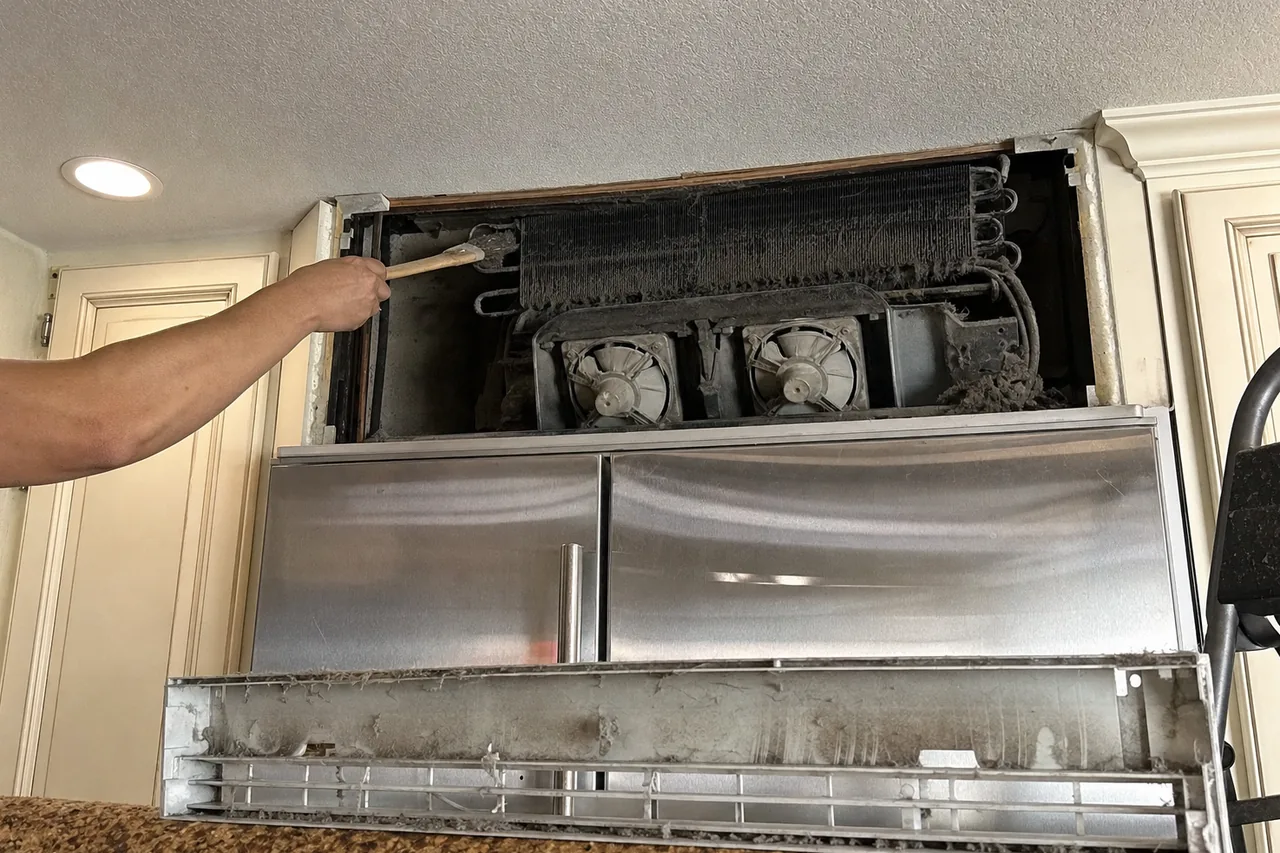
A built-in refrigerator pulls room air across its condenser continuously. Three blocks from the Atlantic, that air carries salt. Salt is hygroscopic: it holds moisture against the aluminium fins and the copper, and it turns ordinary dust into a damp paste that packs the fin gaps instead of blowing through them.
Inland, a condenser might go five years before airflow noticeably drops. Close to the water, the same coil can be visibly loaded in eighteen months. That is not a figure of speech — pull the grille on an oceanfront kitchen in Jacksonville Beach or Neptune Beach and the fin face is often a continuous grey mat rather than a comb you can see through.
What a blocked condenser actually does
Refrigeration works by rejecting heat at the condenser. When the coil cannot shed it, condensing temperature rises, head pressure rises with it, and the system’s capacity falls. The control asks for cooling, gets less of it per minute of run time, and simply never stops asking.
So you get three things at once: a cabinet running a few degrees warm, a compressor that never cycles off, and an electricity bill that has quietly gone up. All three are consistent with a failing compressor, which is why this gets misdiagnosed.
The difference is that a starved condenser is reversible and a compressor that has spent a year at elevated head pressure often is not. Left long enough, the airflow problem becomes a sealed-system problem.
How to tell the difference
Four checks, in order:
- Pull the grille and look at the fin faces. If you cannot see light through the fins, airflow is the problem and nothing else needs diagnosing yet.
- Feel the condenser after a long run. A coil that is barely warm is not rejecting heat — either airflow or refrigerant charge.
- Check the condenser fan. Salt reaches those bearings too, and a fan that has slowed produces the same result as a blocked coil, with a slight change in sound as the only clue.
- Check what is around the appliance. A toe-kick grille covered by added floor trim, or a column installed in a pantry with a solid door, starves a perfectly clean coil.
That last one catches people out. We find it regularly in renovated beach cottages where the flooring went in after the appliance did.
What to do about it
Twice a year at the beach, not once. Brush the fins in the direction they run so you do not fold them over, vacuum rather than blow so the debris leaves the cabinet instead of redistributing inside it, and clean the fan blade while the grille is off — an unbalanced fan is noisy and short-lived.
It is fifteen minutes and it is the single highest-value thing an owner can do for coastal refrigeration. It applies equally to wine columns and under-counter cabinets, which have smaller coils and therefore less margin.
When it is not the coil
If the coil is clean, the fan spins freely, the grille is clear, and the cabinet is still warm, then the sealed system is worth investigating properly — superheat and subcooling measured, not guessed. That work requires an EPA Section 608 certified technician, because handling refrigerant legally does.
At that point the honest conversation is about the age of the cabinet and the cost of the repair against it, and we would rather have that conversation with measurements in hand than sell you a compressor on a hunch.
If it is the fault above
What does this one cost to put right?
The bands that cover the fault this note describes. Parts and labour, fitted, on top of the flat diagnostic that is credited back when the work goes ahead.
| What was actually wrong | Parts and labour, fitted |
|---|---|
| The visit and the diagnosis | $80 flat |
| Refrigeration column sealed system | $870–$2,290 |
The $80 buys the visit and the diagnostic sequence, and it comes off the bill the moment you approve the work. Every row below is a range because what a part costs turns on which production revision is sitting in your cabinetry, and nobody knows that until the rating plate has been read. The whole table is on the pricing page.
Asked after this note
How often should a condenser be cleaned this close to the ocean?
Far more often than the manual assumes, and the interval is set by where the house sits rather than by the calendar. A cabinet a short walk from the breakers loads visibly between cleanings that would be generous inland; the ones on the waterway side go longer.
How do I tell a blocked coil from a failing compressor?
By where the heat goes. A blocked coil leaves the grille air barely warm while the compressor itself runs hot and never cycles off. A failing compressor tends to announce itself through starting behaviour and current draw instead, and the coil is clean when you look at it.
Filed on this fault
What owners said after a visit like this
4.2 out of 5, across 74 customer reviews. What is printed below is one kitchen, one call and one invoice at a time, set down by the owner who settled it.
Interior lighting had died and the display was flickering with it. Rather than order a panel he checked the harness behind the hinge, found a chafed loom, and repaired the run. Everything works and nothing expensive went in.
Delphine K.
It cools now. It took two visits and a lot of chasing by me, because the first assessment blamed a door that turned out to be fine. Polite throughout, but I would have liked a call when the plan changed.
Perpetua N.
The unit stopped making ice altogether after a power cut. He found the fill valve had failed open and then stuck, replaced it and flushed the line, then waited out a whole harvest cycle before calling it done.
Callum B.
Book a visit
A flat $80 diagnostic covers the visit and the diagnosis. It is credited toward the repair if you go ahead with the work.
You get a written estimate before any part is ordered or any labor begins. Nothing is opened up on a maybe. Labor is warranted 90 days. Genuine OEM parts are warranted 365 days from the date of installation.
- Monday – Friday
- 8:00am – 6:00pm
- Saturday
- 9:00am – 4:00pm
- Note
- Closed Sunday. Scheduled appointments only — no emergency or after-hours service.